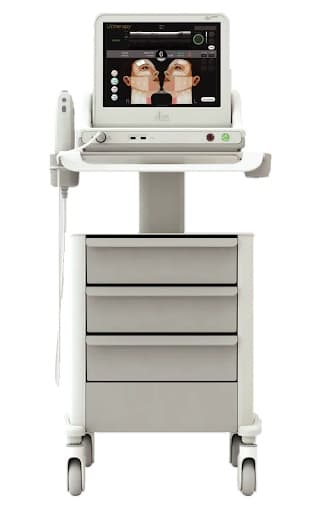
Procedure
Numbing cream or sedation
→ gel applied to the treatment area
→ DeepSEE imaging confirms the internal skin structure
→ cartridges (1.5mm / 3.0mm / 4.5mm) are swapped by zone to deliver focused ultrasound
→ jawline, cheeks, forehead, eye area, and neck are treated in sequence
→ roughly 600–800 shots total. With sedation, you sleep through it and wake up when it's done.
Downtime
Almost none. Mild swelling or redness on the day of treatment typically fades within 1–2 days. Makeup is fine from the same day. Some people get minor bruising that can be covered with makeup.
Effect onset
There's a slight tightening sensation right after, but the real peak is 2–3 months out as new collagen fills in. Around the one-month mark you'll start noticing 'Huh, my jawline looks different.' Some people keep improving up to 6 months.
Effect duration
1 to 1.5 years. With good care, effects can last up to 2 years. Noticeably longer-lasting than Shurink — that's Ultherapy's biggest advantage.
Recommended cycle
Once a year. The long-lasting effect means you don't need it often. Some people slot in a Shurink session between annual Ultherapy sessions for maintenance.
Aftercare
No saunas, steam rooms, or hot-water face washing for 3 days (the ultrasound-induced thermal coagulation points need to heal — adding more heat can cause burns or excessive inflammation)
Apply sunscreen diligently for 2 weeks (heat-treated skin is more prone to pigmentation)
Avoid intense exercise and alcohol for 1 week (overstimulated circulation prolongs swelling and increases bruising)
Keep up consistent moisturizing (heat dries out the skin, and moisture supports a better collagen-building environment)
Side effects
The most important risks are cheek hollowing and nerve irritation. With stronger energy comes greater potential side effects compared to Shurink, so proper technique is critical.
Not recommended for
People with very little cheek fat and prominent bone structure (strong energy can melt fat, causing severe cheek hollowing that's hard to reverse)
Significant filler volume in the treatment area
Pregnant or breastfeeding
Keloid-prone individuals (may overreact to thermal stimulation)
Recent strong chemical peels or laser treatments within the past 2 weeks (compromised skin barrier)
Best combos
Ultherapy + Thermage: Ultherapy lifts deep, Thermage tightens the surface — the gold-standard combination for lifting + tightening.
Ultherapy + Skin Botox: Lift the jawline while smoothing pores and fine lines.
Ultherapy + Voluma Filler: Lift while filling in sunken areas — especially good for people worried about cheek hollowing.
Differences from others
Ultherapy vs. Shurink: Both are HIFU, but they're different tiers. Ultherapy has US FDA clearance for lifting and uses real-time imaging (DeepSEE) to see what it's targeting — it's more precise, more powerful, and lasts longer (1+ year). Shurink is Korean-made, 1/5 to 1/10 the price, but effects last only 3–6 months. Ultherapy vs. Thermage: Ultherapy lifts by pulling from deep tissue; Thermage tightens the surface layer to firm things up. If sagging is your concern, go Ultherapy. If it's elasticity and fine lines, go Thermage.
Price
Full face: ₩1,000,000–2,000,000 / Partial (jawline only, etc.): ₩500,000–800,000 (as of 2025). Some promotional prices for full face start at ₩800,000.
Why prices differ
The device itself is extremely expensive (hundreds of millions of won), and each genuine tip costs hundreds of thousands of won. It's a Merz (US) exclusive device with price controls, and each tip is single-use with a shot limit — the raw cost is simply high. That's why it's 5–10x more expensive than Shurink. Even within Ultherapy, price varies by shot count, genuine tip verification, and whether a doctor performs it personally.
Hospital selection tips
1) Verify the tip's serial number — genuine Ultherapy tips have serial numbers printed on them. Counterfeit or reused tips deliver inconsistent energy, risking burns, poor results, and linear marks. Ask them to open the new tip in front of you.
2) Confirm the doctor performs it personally. Ultherapy energy is strong and requires anatomical knowledge — having a nurse or aesthetician do it significantly increases the risk of cheek hollowing and nerve damage.
3) Ask whether they use DeepSEE imaging during the procedure. Real-time visualization is Ultherapy's core advantage — if they skip it and go by feel alone, you're losing the main reason to pay for Ultherapy.
4) Make sure they customize the shot plan for your facial volume. If you have thin cheeks and they blast high energy there, severe cheek hollowing can result. During consultation, explicitly say 'please avoid areas where my cheeks are already hollow.'